English


Introduction
When people want safe and steady growth, they often look for simple products. So, two common choices are Target Maturity Funds and SFB FDs. Both can give fixed-income style returns, and both can look easy at first. However, they work in different ways. Therefore, it is important to compare them carefully before you invest.
Also, many readers want very simple answers. So, this blog explains everything in easy words. In addition, it shows how returns, taxes, safety, and liquidity differ. As a result, you can choose the option that fits your goal better.
What Are Target Maturity Funds
Target Maturity Funds are debt mutual funds. They invest in bonds and similar fixed-income papers. Usually, these papers mature around one common date. Because of this setup, the fund follows a clear maturity plan.
These funds are not fully guaranteed. Still, they may feel more stable than many other mutual funds if you hold them till maturity. Moreover, they can suit medium-term goals because the fund keeps a fixed end date in mind.
What Are SFB Fixed Deposits
SFB FDs are fixed deposits from Small Finance Banks. You put money in for a fixed time. Then, the bank pays fixed interest after that period or at regular intervals, depending on the plan.
This product is very easy to understand. At the same time, it may offer a higher rate than some large banks. However, safety still matters. In India, DICGC insures deposits up to ₹5 lakh per depositor per bank, including principal and interest.
Why Compare Target Maturity Funds and SFB FDs
People compare these two products because both aim for steady returns. Yet, they are not the same. One is a mutual fund. The other is a bank deposit. Therefore, the risk, tax, and withdrawal rules are different.
Also, the headline rate can mislead people. For example, a high FD rate may still give a lower final value after tax. On the other hand, a Target Maturity Fund may give better post-tax returns in some cases. So, the full picture matters a lot.
How Target Maturity Funds Work
Target Maturity Funds buy bonds that mature near a chosen date. Then, as time passes, the fund moves closer to that date. Because of this, the portfolio becomes easier to plan around.
Also, the fund holds many debt papers, not just one. So, the return comes from bond yields and accrual income. If you stay invested till maturity, the outcome can become more visible. Even so, it is still not a guaranteed return like a bank deposit.
How SFB FDs Work
SFB FDs are very direct. You deposit money, choose the time period, and lock in the rate. Then, the bank pays the agreed interest after maturity or during the term, based on the deposit type.
Because of this, the return looks simple and clear. In addition, the interest rate does not change after booking. However, if you break the FD early, the bank may reduce the interest or charge a penalty. So, the final amount may become lower than expected.
Returns Comparison
| Feature | Target Maturity Funds | SFB FDs |
| Return type | Expected return, not guaranteed, but more visible if held till maturity | Fixed interest under the deposit terms |
| Return source | Bond yields and accrual income | Bank deposit interest |
| Post-tax outcome | Can improve after-tax return for some investors | Tax depends on the slab, so the net return may be reduced |
| Rate movement impact | Lower impact if held till maturity | Rate stays fixed after booking |
| Early exit impact | NAV may move if you exit early | Penalty may apply on premature withdrawal |
So, if you want a simple fixed rate, SFB FDs may feel better. However, if you want possible tax efficiency and are ready to stay invested longer, Target Maturity Funds may be attractive. In short, the better return depends on your full situation.
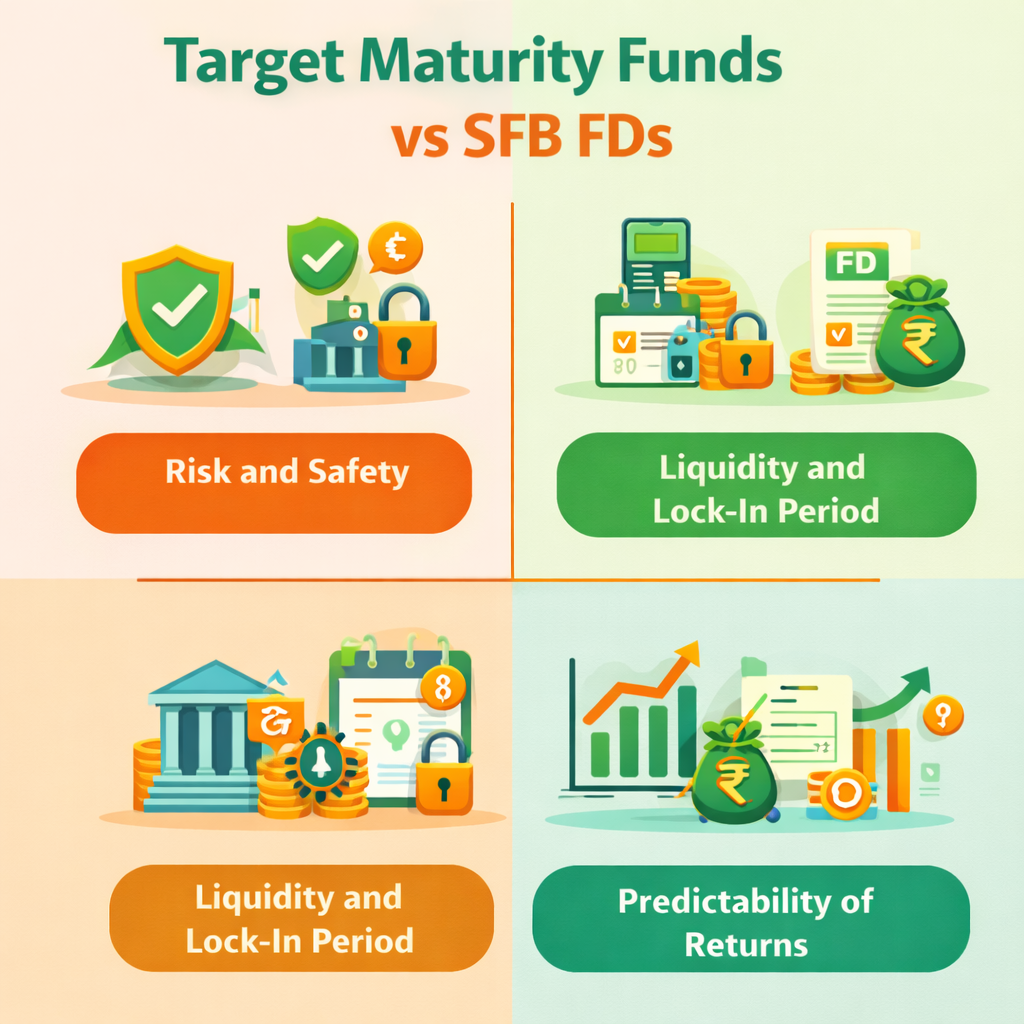
Risk and Safety Comparison
SFB FDs have a clear safety layer through DICGC insurance. In fact, up to ₹5 lakh per depositor per bank is covered, including principal and interest.
Still, if your deposit is above that amount, the extra money depends on the bank’s strength. By contrast, Target Maturity Funds do not come with bank-style insurance. Instead, they carry bond-related risks, such as interest rate risk and credit risk.
Liquidity and Lock-In Period
Target Maturity Funds are usually open-ended. So, you can redeem them when needed. However, if you exit early, the value may change with the market. Therefore, you may not get the result you expected.
SFB FDs are less flexible. You can often withdraw early, but the bank may lower the interest or apply a penalty. As a result, your final return may fall. So, both products can have exit costs, just in different ways.
Tax Treatment of Both Options
Tax can change the real return a lot. FD interest is usually taxed as per your income tax slab. Also, banks may apply TDS if the interest crosses the allowed limit.
Target Maturity Funds may be more tax-friendly in some cases. For example, if you hold them for more than 3 years, debt mutual fund rules may allow long-term capital gains treatment with indexation in eligible cases. So, the post-tax outcome can improve for some investors.
Predictability of Returns Explained
Predictability does not always mean a full guarantee. Instead, it means you can estimate the outcome more clearly. That is why many people like fixed-income products.
SFB FDs are easier to predict because the rate is fixed from day one. Target Maturity Funds are also fairly predictable if you stay till maturity. Yet, they still depend on the bond portfolio and fund structure. Therefore, they are slightly less direct than an FD.
Who Should Choose Target Maturity Funds
Target Maturity Funds may suit people who want medium-term investing. Also, they may suit investors who care about tax efficiency and can wait till maturity. If you can hold the investment for the full period, the result may be more useful for your goal.
They may also work well for disciplined investors. In addition, they fit people who do not need daily liquidity. So, if you can keep the money invested and stay patient, this option may make sense.
Who Should Choose SFB FDs
SFB FDs may suit people who want easy and fixed returns. Also, they are good for those who do not want to follow market-linked products. The rate is clear at the start, which gives comfort to many savers.
They may also work for short-term goals. However, you should check the deposit insurance limit first. That is especially important if you plan to invest a large sum in one bank.
Things to Consider Before Investing
First, think about your time horizon. If you need the money soon, an early exit can hurt both options. So, match the product with your goal date.
Second, look at tax after returns, not just before-tax rates. Also, check how much safety you need, how easily you may need cash, and how much risk you can accept. In short, choose with care, not just with a high rate number.
Conclusion
For predictable returns, SFB FDs feel simpler. The interest is fixed, the product is easy to understand, and the structure is familiar. Therefore, many conservative savers may prefer it. For a high interest rate FD, start investing in WeRize Fixed Deposit.
At the same time, Target Maturity Funds can be a smart choice for some investors. They may offer better tax efficiency and a goal-based path if you hold them till maturity. So, the best option depends on your needs, your tax slab, and your holding period.
FAQs
1. Are Target Maturity Funds guaranteed?
No, they are not fully guaranteed. However, they can offer better return visibility if you hold them till maturity.
2. Are SFB FDs safe?
They are safe up to the DICGC cover limit of ₹5 lakh per depositor per bank, including principal and interest.
3. Which gives better post-tax returns?
That depends on your tax slab and holding period. For longer holding periods, Target Maturity Funds may offer tax benefits, while FD interest is taxed as per the slab.
4. Can I withdraw early from both?
Yes, but early exit may reduce the final return in both cases. Target Maturity Funds may face NAV movement, and FDs may face a penalty or lower interest.
5. Which is better for simple readers?
SFB FDs are simpler to understand. Target Maturity Funds are still easy enough, but they need a little more attention to tax and holding period.