English


Are you looking for extra funds today? You might want to buy a car. Maybe you want to start a business. Perhaps you need to pay for a wedding. Therefore, you need a loan. However, banks offer many different choices. The biggest choice is between secured vs unsecured loans. First, you must understand both options clearly. Specifically, we will look at a Loan Against Property (LAP). We will also look at a standard Personal Loan. Furthermore, making the wrong choice can cost you huge money. Consequently, you must read this complete guide carefully. This article breaks down everything in simple terms. Additionally, it helps you make a smart choice. Hence, you can protect your financial future easily. Let us explore these two loan types together.
What Are Secured Loans? (Loan Against Property)
A secured loan requires a physical asset. You must give the bank a strict guarantee. For example, you can pledge your house. You can also pledge your car or gold. The bank holds this asset as collateral safely. If you stop paying, the bank takes your asset. Therefore, the bank feels very safe. As a result, they offer lower interest rates. A Loan Against Property (LAP) is a perfect example. You pledge your house directly to the bank. After that, the bank gives you a large sum. Moreover, you can use this cash for anything. However, you must pay the bank back quickly. Otherwise, you will lose your beloved property. Furthermore, LAP gives you a long time to repay. Thus, your monthly payments stay very low. This makes the loan easier to manage.
What Are Unsecured Loans? (Personal Loan)
An unsecured loan works very differently. You do not need an asset at all. The bank trusts your monthly income. They also trust your good credit score. Therefore, you do not pledge your house. A personal loan is the perfect example here. You simply apply online from your phone. You can also visit a local branch. After checking your credit score, the bank gives you money. Consequently, the process is incredibly fast. However, the bank takes a huge risk. They have no assets to sell. Because of this risk, the bank charges higher interest rates. Additionally, they give you less time to repay. Typically, personal loans last one to five years. Furthermore, the loan amount is much smaller. Hence, it works best for quick emergencies.
Key Differences: Secured vs Unsecured Loans
Now, let us compare secured vs unsecured loans directly. Both options help you get money fast. However, they serve very different life needs. For instance, LAP gives you big money. In contrast, personal loans give you quick money. Therefore, you must match the loan to your goal. Let us look at a simple table to understand better.
| Feature | Secured Loan (LAP) | Unsecured Loan (Personal Loan) |
| Collateral | Property required. | No asset required. |
| Interest Rate | Generally lower. | Generally higher. |
| Loan Amount | Very high limits. | Smaller limits. |
| Approval Time | Slow process taking weeks. | Fast process taking days. |
| Repayment Time | Long time up to 20 years. | Short time up to 5 years. |
| Credit Score | Medium focus. | High focus. |
| Borrower Risk | High risk to lose property. | Low risk to property. |
As you can see, the differences are very clear. Secured loans take much more time. Meanwhile, unsecured loans move incredibly fast. Furthermore, secured loans risk your real estate. Conversely, unsecured loans only hurt your credit score if you fail. Ultimately, each loan has a specific purpose.
Benefits of a Loan Against Property (LAP)
First, LAP offers extremely low interest rates. Since you pledge your property, the bank takes less risk. Therefore, you save big money on interest charges. Second, you can borrow a huge amount. If your house is highly valuable, you get lots of cash. For example, you can fund a huge business expansion easily. Third, you get a long time to repay the money. Sometimes, banks give you 15 or 20 full years. Consequently, your monthly payment remains small. Furthermore, you still own and use your property daily. The bank does not kick you out of your home. You just cannot sell it until you clear the debt. Additionally, the approval rules are sometimes very flexible. Even with a normal credit score, you might get approved.
Drawbacks of a Loan Against Property
However, LAP has some big risks too. The biggest risk involves losing your actual property. If you lose your job and stop paying, the bank acts. They take your house and sell it. Therefore, you must plan your finances carefully. Second, the approval process takes a long time. The bank must check your property papers strictly. They send experts to check the exact value of your house. Consequently, this whole process can take several weeks. Thus, it is bad for sudden emergencies. Furthermore, you must pay hidden fees upfront. For instance, banks charge property valuation fees and processing fees. These costs add up very quickly. Lastly, you tie up your most valuable asset entirely. If you want to sell your house later, you must clear the loan first.
Benefits of a Personal Loan
A personal loan offers incredible speed for borrowers. First, you get the money very fast. Many banks approve personal loans in just one day. Therefore, it is perfect for sudden medical emergencies. Second, you do not risk any physical assets. You keep your house and your gold perfectly safe. If things go wrong, you only hurt your credit score. Furthermore, the paperwork is extremely simple. You just show your salary slips and PAN card. You do not need property papers or complex legal checks. Consequently, you save a lot of valuable time. Additionally, you can use the money anywhere you want. The bank never asks how you spend the cash. Hence, you can buy a laptop, take a trip, or pay hospital bills easily.
Drawbacks of a Personal Loan
Despite the clear benefits, personal loans have drawbacks. First, they cost much more. Since the bank takes a huge risk, they charge high interest rates. Therefore, you pay more total money over time. Second, the loan amounts are quite small. You cannot borrow enough to buy a factory or a new house. Usually, banks cap the limit based entirely on your monthly salary. Furthermore, you get less time to repay the debt. You must clear the debt within a few short years. Consequently, your monthly payments become very large. This puts heavy pressure on your monthly family budget. Lastly, banks demand an excellent credit score from you. If your score is low, they will reject your application instantly. Thus, not everyone can get a personal loan easily.
How to Choose Between LAP and Personal Loan?
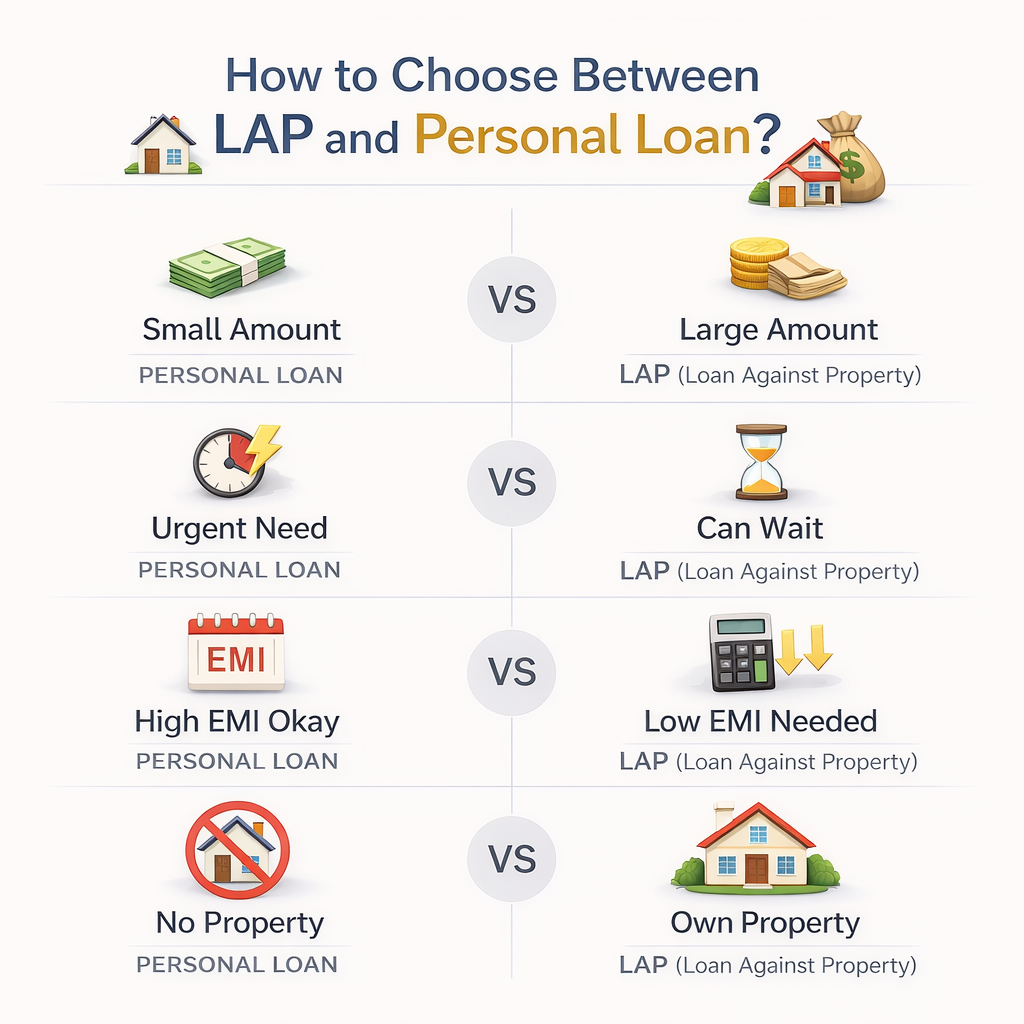
You must look at your own needs to choose well. First, ask yourself how much money you need right now. If you need a small amount, choose a personal loan. However, if you need a huge amount, choose LAP. Second, think about your exact timeline. Do you need cash today? Therefore, you must pick the personal loan. In contrast, if you can wait a month, LAP works well. Third, consider your direct ability to repay. Can you handle large monthly payments easily? If yes, a personal loan is totally fine. If no, LAP gives you smaller payments over a longer time. Furthermore, look at your current assets. Do you own a house? If you do not own property, you cannot get LAP. Consequently, the personal loan becomes your only choice. Always match the loan type to your situation.
Common Mistakes to Avoid When Borrowing
When choosing between secured vs unsecured loans, people make big mistakes. First, they borrow more than they actually need. The bank might offer you a huge amount happily. However, you must only take what you absolutely require. Furthermore, extra money simply means extra interest payments. Second, many borrowers ignore the fine print completely. They only look at the basic interest rate. Consequently, they miss processing fees, late payment charges, and foreclosure fees. Therefore, you must read the entire loan agreement slowly. Third, borrowers hide existing debts from the bank. The bank will find out anyway through your credit report. Thus, hiding facts leads to instant rejection. Additionally, people fail to plan for future emergencies. They assume their income will never stop. Hence, always keep an emergency fund ready.
Understanding Your EMI
EMI stands for Equated Monthly Installment. This is the exact amount you pay the bank every month. Your EMI contains two separate parts. The first part is the principal loan amount. The second part is the interest charge. In the early years, the interest portion is very high. Therefore, your principal balance drops very slowly. Over time, the principal portion grows larger. Furthermore, you can use online calculators to check your EMI. You should do this before applying. Consequently, you will know exactly how much you must pay. If the EMI looks too big, you have two choices. You can borrow less money immediately. Alternatively, you can choose a longer repayment time. Thus, your monthly burden decreases significantly. However, a longer time means you pay more total interest. Always find a good balance.
Smart Tips for Borrowers
Before you apply, follow these smart tips carefully. First, always check your credit score online. A high score gets you much cheaper rates. Second, compare different banks thoroughly. Do not just go to your regular bank blindly. Look around for the absolute best deal. Therefore, you can save thousands of rupees. Third, always read the fine print twice. Look for hidden fees and strict penalty charges. Furthermore, never borrow more than you need. A large loan means large interest. Consequently, you lose money. Additionally, plan your monthly budget carefully. Make sure you can pay the EMI without stress. Set up auto-pay from your main bank account. Thus, you will never miss a payment. Always remember that taking a loan is a serious promise.
Conclusion
In conclusion, understanding secured vs unsecured loans helps you win. It allows you to make smart financial choices. A Loan Against Property offers big money at cheap rates. However, it puts your beloved house at risk. On the other hand, a personal loan gives you fast cash. Yet, it charges much higher interest. Therefore, you must balance your needs carefully. Analyze your emergency level, required amount, and repayment power. Furthermore, always act responsibly with your money. Pay your EMIs on time every month. Consequently, you build a very strong credit profile. A strong profile unlocks better financial products in the future. Ultimately, both loans serve specific life purposes. Choose the one that fits your current life stage perfectly. We hope this guide brings you total clarity and confidence.
FAQs
1. What is the main difference between secured vs unsecured loans?
The main difference involves collateral. Secured loans require an asset like a house. Unsecured loans do not require any asset at all. Therefore, unsecured loans rely purely on your steady income.
2. Which loan is actually cheaper: LAP or Personal Loan?
LAP is always cheaper. Because you pledge your property, the bank takes less risk. Consequently, they offer lower interest rates compared to personal loans.
3. Can I get a personal loan with a bad credit score?
It is very difficult. Banks rely heavily on your credit score for unsecured loans. Therefore, a bad score usually leads to quick rejection. However, you might still get a secured loan.
4. How long does a Loan Against Property take to process?
It usually takes one to three weeks. The bank must check your property papers strictly. Furthermore, they evaluate the exact property value. Consequently, the process moves quite slowly.
5. Can the bank really take my house if I fail to pay LAP?
Yes, absolutely. When you sign the LAP agreement, you give the bank legal rights. If you stop paying, they can auction your house. Therefore, you must always pay on time.
6. Is it smart to use LAP to clear personal loans?
Yes, many smart people do this. LAP interest rates are much lower. Therefore, using LAP to close expensive personal loans saves you money. We generally call this debt consolidation.