English


Introduction
Have you ever wondered what DSA means in banking? What is the full form of a DSA? What are the benefits of being a DSA? Perhaps you’ve heard the term “Direct Selling Agent” and want to know more?
DSA’s full form is Direct Selling Agent. These professionals play an important role in India’s financial system. They help millions of people access loans easily. Moreover, DSAs earn attractive commissions while helping others.
While the DSA business is roaring in India. Thousands of people are choosing this career path. But why? Because the DSA benefits are impressive: Flexible work, good income, and no investment required.
In this complete guide, you’ll get to know everything about a DSA’s full form in banking. You’ll learn what Direct Selling Agents do, how they work, and how you can become one. Additionally, the guide covers commission structures, legal aspects, and future opportunities.
So, let’s dive in and explore this exciting career opportunity!
DSA Full Form
DSA stands for Direct Selling Agent.
This term is widely used in the banking and financial services industry. The DSA’s full form apparently indicates what these professionals do: They directly sell financial products to potential customers.
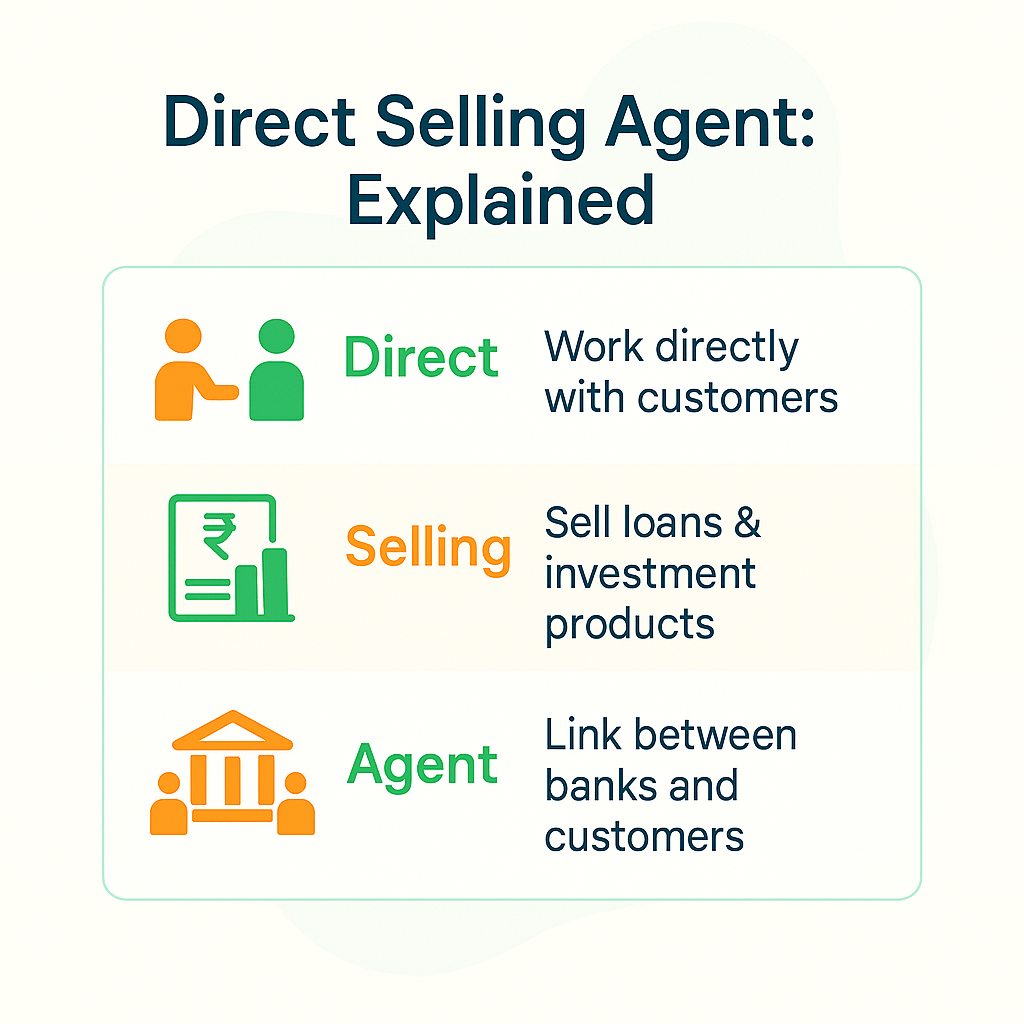
Breaking Down the DSA Full Form
- Direct: DSAs work directly with customers face-to-face
- Selling: They sell or promote financial products like loans or investment products
- Agent: They act as mediators between banks and customers
Other Names for DSA
The Direct Selling Agent is also known by various names:
- Loan Agent
- Credit Agent
- Financial Agent
- Banking Agent
- Loan Facilitator
- Loan consultant
- Loan Connector
However, the most common term remains DSA. Therefore, when you hear DSA’s full form in banking, remember it means Direct Selling Agent.
What is a DSA (Direct Selling Agent)?
A DSA is an authorized person or entity that partners with banks, NBFCs, and fintech platforms. Their main job is to help these institutions reach more customers. They promote and sell various financial products, especially loans.
The Role of a Direct Selling Agent
DSAs act as a bridge between lenders and borrowers. Here’s what they do:
For Customers:
- Explain different loan options
- Help choose the right loan product
- Assist in completing applications
- Guide through documentation
- Follow up until loan disbursal
For Lenders:
- Find potential customers
- Generate quality leads
- Verify basic information
- Submit complete applications
- Reduce customer acquisition costs
Why Are DSAs Important?
Banks or NBFCs cannot reach every corner of India directly. Therefore, Direct Selling Agents fill this gap. They bring financial services to people’s doorsteps, especially in tier 2 and tier 3 cities. Moreover, DSAs understand local customers better and speak their language.
How Does a DSA Work?
The DSA working process is straightforward:
- Step 1: Partnership Agreement – Partner with a bank or NBFC through a formal agreement.
- Step 2: Customer Identification – Find potential customers who need loans through networking, referrals, or marketing.
- Step 3: Product Consultation – Explain available loan products, eligibility criteria, and terms.
- Step 4: Application Submission – Help complete the loan application and collect required documents.
- Step 5: Verification Support – Coordinate between the customer and lender during verification.
- Step 6: Loan Disbursal – Ensure the customer understands the repayment timetable after approval.
- Step 7: Commission Payment – Receive commission after every successful loan disbursal.
The Commission-Based Model
DSAs don’t receive fixed salaries. Instead, they earn commissions on every successful loan disbursal. This performance-based model means unlimited earning potential for dedicated experts.
Types of DSAs in Banking
In the banking and financial sector, Direct Selling Agents (DSAs) come in different forms based on their structure, scale of operation, and partnership model with lenders. Here are the main types of DSAs in banking:
1. Individual DSAs
These are independent agents who work alone with one or multiple banks or NBFCs. They usually manage limited customer volumes, operate within specific local areas, and focus on building personal relationships with clients.
2. Corporate DSAs
Corporate DSAs are registered companies or firms that operate on a larger scale. They have multiple employees, serve broader regions, and often tie up with several lenders to offer a wide range of financial products.
3. Master DSAs
Master DSAs are experienced experts or organizations that manage a network of sub-DSAs. They recruit, train, and support other DSAs, earning a share of their commissions. Their goal is to build a large distribution network across cities or regions.
4. Authorized Representatives
These DSAs work exclusively with a single bank or financial institution. They receive official authorization, training, and marketing support from the bank, helping them promote specific loan or credit products more effectively.
Each type has its advantages. Individual DSAs enjoy maximum flexibility. Corporate DSAs handle higher volumes. Master DSAs build business empires.
DSA vs. Loan Agent: Are They the Same?
The Simple Answer
DSAs work independently and are not bank employees, while loan agents work directly for banks or loan companies and get job security and benefits.
| Aspect | DSA (Direct Selling Agent) | Loan Agent |
| Employment Status | Independent agent, not an employee of any bank | Employee of a bank or loan agency |
| Scope of Work | Can work with multiple lenders and offer various loan products | Works for one financial institution & promotes only the employer’s products |
| Earnings | Commission-based income + Higher earning potential | Fixed salary plus incentives + Limited earning potential |
| Registration | Requires business registration (PAN, GST, agreements) | Works under the employer’s license; fewer personal requirements |
| Market Reach | Can target multiple customer segments and regions | Works within assigned areas as per company policy |
| Flexibility | Full independence and flexible work style | Follows company rules and schedules; less autonomy |
Why Two Different Names?
“Direct Selling Agent” is the formal, official term. “Loan agent” is more commonly used in everyday language. However, they perform identical functions.
Benefits of Being a DSA (Direct Selling Agent)
Let’s explore the exciting DSA benefits that draw thousands of people to this career.
Benefits for DSAs/Loan Agents
- Attractive Commission Income
DSAs typically earn 0.5% to 4% commission on loan amounts. Top-performing DSAs earn Rs. 50,000 to Rs. 1,00,000+ monthly.
- Zero Investment Required
Unlike traditional businesses, the DSA business needs no capital investment. No office rent, merchandise, franchise fees, or equipment needed. This makes it affordable to everyone.
- Complete Work Flexibility
You’re your own boss with flexible hours, work from anywhere, no fixed daily targets, and the ability to balance with other commitments.
- Multiple Income Streams
Partner with multiple banks and NBFCs simultaneously. Offer various loan products, serve different customer segments, and increase overall earnings.
- Business Ownership
Build your own brand, create a potential customer base, develop valuable customer relationships, and create long-term business value.
- Low Risk, High Reward
Minimal business risk with no inventory, no loan liabilities, no commitment if customer defaults, yet considerable reward potential.
- Continuous Learning
Learn financial product knowledge, sales and marketing skills, customer relationship management, and business development strategies.
- Social Impact
Help people fulfill dreams, support business growth, contribute to financial inclusion, and become a trusted financial advisor in your community.
Benefits for Customers
- Easy access to loans at their doorstep
- Expert guidance on choosing products
- Faster processing with complete documentation
- Multiple options from different lenders
- Free professional service
Benefits for Banks and NBFCs
- Extended market reach to remote areas
- Cost-effective distribution channel
- Local market knowledge and language expertise
- Reduced customer acquisition costs
How to Become a DSA/Loan Agent?
Basic Eligibility Criteria
- Age: Minimum 21 years
- Education: At least high school; graduates preferred
- Experience: Not mandatory, but helpful
- Background: Clean criminal and credit record
Required Documents
- Identity Proof: PAN Card (mandatory), Aadhaar Card, Passport/Driving License
- Address Proof: Aadhaar, utility bills, rental agreement
- Financial Documents: Bank details, cancelled cheque, bank statement
- Business Documents: Registration certificate, GST (if applicable)
- Photographs: Passport-size photos
Registration Process
- Step 1: Research and choose lenders you want to partner with.
- Step 2: Contact the lender through their website or branch.
- Step 3: Register with all required documents.
- Step 4: Complete background verification (7-15 days).
- Step 5: Sign a formal DSA agreement after approval.
- Step 6: Attend product training sessions.
- Step 7: Receive your unique DSA code or ID.
- Step 8: Start working and earning!
loan agent.
Here’s how you can register on the WeRize Partner app:
Step 1: Download and Install the WeRize Partner App from the Play Store
Step 2: Sign in using your mobile number & complete the OTP verification process.
Step 3: Now, select your reason for joining as: “Sell WeRize loans to other customers.”
Step 4: Next, fill in your basic personal details, such as your PAN number, email ID, pin code of your current address & preferred language, and click “Proceed”.
If your CKYC is not auto-fetched, you will have to verify your Aadhaar details. Enter your Aadhaar number and the OTP received on your Aadhaar-linked mobile.
And if your CKYC is auto-fetched, continue to the next step.
Step 5: Further, you’ll be asked to take a selfie using your phone’s front camera. Tap “Capture Photo” to upload your photo. Once it is verified, you’ll see a “Verification Successful” message on screen.
Step 6: To receive commission payments, you have to add your bank account details.
That’s it, and the registration is completed.
DSA Commission Structure
- The commission structure for Direct Selling Agents (DSAs) depends on the type of loan, lender policies, and overall business generated. DSAs typically earn between 0.5% 4% commission on the loan amount disbursed.
- Their income is performance-based, meaning the more successful loan applications they process, the higher their earnings. Top-performing DSAs can make anywhere from ₹50,000 to ₹1,00,000 or more per month, depending on their effort, network, and consistency.
- Some financial institutions also offer bonuses and rewards for attaining precise targets or holding high-quality leads. This system facilitates DSAs to build trust with customers and deliver strong results for their lending partners.
- Commission Payment Methods
- Upfront Commission: The Entire commission amount is paid instantly after disbursal.
- Split Payment: A Part of the commission is paid at disbursal, and the rest after a few months.
- Recurring Commission: Paid in installments over the loan tenure.
- Trail Commission: Ongoing commission on EMIs or additional products.
Skills Required to Succeed as a DSA
Essential Skills
- Communication Skills – Understand customer needs, explain products clearly, and answer confidently.
- Sales and Effectiveness – Identify needs, present solutions, handle rejections, and close deals.
- Basic Financial Knowledge – Interest rates, EMI calculations, credit scores, and loan types.
- Customer Relationship Management – Follow up regularly, maintain records, provide support, and ask for referrals.
- Documentation Skills – Verify carefully, ensure completeness, maintain records, and submit correctly.
- Networking Abilities – Build connections, attend events, maintain reputation, and use social media.
- Time Management – Prioritize activities, balance customers, and meet deadlines consistently.
- Technology Skills – Use smartphones, navigate apps, send documents, and conduct video calls.
- Problem-Solving – Think creatively, find solutions quickly, stay calm, seek help when needed.
- Ethical Behavior – Provide honest information, disclose terms, protect privacy, and follow guidelines.
Legal and Regulatory Aspects
RBI Guidelines for DSAs
DSAs must follow these guidelines:
- Have valid contracts with official lenders
- Maintain moral standards and code of conduct
- Shield customer privacy and data
- Follow fair practices in selling
- Provide full product details
- Not misrepresent or make false promises
Registration Requirements
Individual DSAs: PAN Card mandatory, GST if earnings exceed a point.
Corporate DSAs: Company registration, GST registration, Professional Tax, Shop Act registration.
Tax Implications
Income Tax: DSA commission is business income. File ITR annually and pay advance tax if applicable.
GST: Register if annual income exceeds Rs. 20 lakhs. Charge GST on commissions and file returns regularly.
TDS: Some lenders deduct TDS. Collect certificates and claim credit in ITR.
Consumer Protection
Respect customer rights to information, fair treatment, privacy, and grievance redressal. Breaking rules can result in termination of the agreement, legal action, or criminal charges.
How to Choose the Right Financial Institution
Key Factors to Consider
1. Commission Structure – Compare commission rates across lenders. Higher isn’t always better if approval rates are low.
2. Product Range – More products represent more earning options and better customer service.
3. Approval Rates – Partner with lenders having good approval rates to maximize your conversion.
4. Payment Track Record – Check if they pay commissions on time without unnecessary delays.
5. Training and Support – Good lenders provide extensive training, ongoing, and dedicated support.
6. Technology Platform – User-friendly apps and systems make your work more comfortable and faster.
7. Brand Reputation – Established brands are easier to sell and build customer trust.
8. Eligibility Criteria – Understand their customer requirements to ensure a good match with your target market.
9. Territory Flexibility – Some lenders limit territories, while others allow pan-India operations.
10. Agreement Terms – Read carefully for hidden clauses, termination conditions, and renewal terms.
Tips for Selection
- Don’t join too many lenders initially (start with 2-3)
- Talk to existing DSAs about their experience and gain knowledge
- Check online reviews and forums
- Start with established players before trying new companies
- Diversify across various lender types (banks, NBFCs, fintech)
Conclusion
Now you know what DSA stands for: Direct Selling Agent, and understand this rewarding career opportunity.
The DSA benefits are clear: attractive commissions, zero investment, flexible working, multiple income streams, and social impact. Whether you want extra income or a full-time career, the DSA model offers both.
Yes, there are income fluctuations, competition, and rejection. However, thousands of successful loan agents prove these are manageable with the right approach.
The future of DSA business in India looks bright. Financial inclusion, growing credit demand, and technology adoption create continuous possibilities. Moreover, tier 2 and tier 3 cities remain largely untapped.
If you have good communication skills, basic financial knowledge, and a willingness to help people, becoming a Direct Selling Agent could be your path to financial independence. Start by exploring potential financial institutions, understanding their products, and taking the first step.
Remember, every successful DSA started exactly where you are now. The difference? They took action. So, what are you waiting for?
Ready to start your DSA journey? Research lenders today, gather your documents, and register to begin earning!
Frequently Asked Questions
Q1: What is the full form of DSA in banking?
DSA’s full form is Direct Selling Agent. These are authorized mediators who help banks and NBFCs sell loan products to customers.
Q2: What does a Direct Selling Agent do?
A Direct Selling Agent finds potential loan customers, explains loan products, helps with applications, collects documents, and simplifies the loan process. They earn commission on successful loan disbursals.
Q3: How much do DSAs earn?
DSA earnings vary widely. Part-time DSAs earn Rs. 10,000-20,000 monthly. Full-time dedicated DSAs can earn Rs. 50,000-1,00,000+ monthly depending on loan volumes and commission rates.
Q4: Is DSA’s business profitable?
Yes, DSA business can be very profitable. However, success requires consistent effort and customer acquisition skills.
Q5: Do I need investment to become a DSA?
No, becoming a DSA requires zero financial investment. You don’t need office space, inventory, or franchise fees. Just basic documents and a smartphone are adequate to start.
Q6: Can I work as a DSA part-time?
Yes, absolutely! Many successful DSAs work part-time alongside regular jobs or other commitments. The flexible nature of DSA work makes it ideal for part-time income.
Q7: Which documents are required to become a DSA?
Basic documents include PAN Card (mandatory), Aadhaar Card, address proof, educational certificates, bank account details, and photographs. Corporate DSAs need additional business registration documents.
Q8: How do DSAs get paid?
DSAs receive commission as a percentage of the loan amount. Payment is typically made via bank transfer within 7-30 days after loan disbursal. Commission rates range from 0.5% to 4% depending on the loan product.
Q9: Is DSA registration mandatory?
Yes, you must register formally with a bank or NBFC to work as their DSA. You cannot facilitate loans without a valid DSA agreement. Registration includes documentation, background verification, and agreement signing.
Q10: Can I partner with multiple lenders?
Yes, most DSAs partner with multiple banks and NBFCs simultaneously. This allows you to offer customers more options and increases your earning potential from different sources.
Q11: Do DSAs need prior experience?
No, prior experience is not mandatory. Most lenders provide training to new DSAs. However, sales experience and financial knowledge help you succeed faster.
Q12: What is the future of the DSA business?
The DSA business has a bright future in India. Growing credit demand, financial inclusion initiatives, limited bank penetration in smaller cities, and fintech expansion create continuous opportunities for DSAs.
Q13: How to choose the best lender to partner with as DSA?
Consider commission rates, product range, approval rates, payment track record, training support, technology platform, and brand reputation. Start with established lenders and diversify gradually.