English


1. Introduction to High-Value Lending in 2026
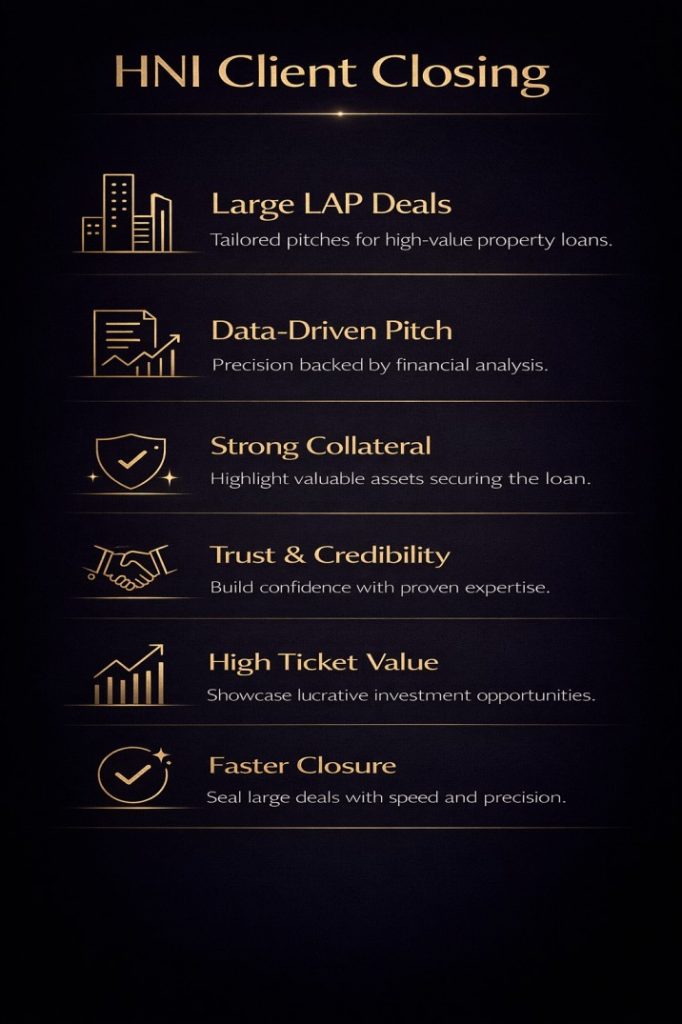
In the fast-moving financial world of April 2026, working with High Net Worth Individuals (HNIs) requires a very different mindset. Initially, many agents think that an HNI client only cares about the lowest interest rate. However, this is a common mistake. Specifically, a wealthy client values their time, their tax efficiency, and their long-term wealth growth much more than a few basis points. Consequently, when you are pitching a Loan Against Property (LAP) for ₹10 Crore or ₹50 Crore, your presentation must be world-class. Therefore, moving from a simple “loan seller” to a “strategic advisor” is the only way to win in 2026. This guide will show you how to master Strategic Liquidity Unlocking via High-Value LAP to close the biggest deals of your career.
To begin with, we must recognize that HNIs in 2026 are highly informed. They have access to global markets and advanced digital tools. Actually, they don’t just want a loan; they want Asset-Backed Credit Facilities for HNIs 2026 that fit into their larger financial plan. Initially, you might feel intimidated by the scale of these deals. But if you focus on “Problem Solving” instead of “Product Selling,” you will find success. Furthermore, the Indian economy is booming, and many business owners need large amounts of capital to expand. Therefore, your pitch deck should be a roadmap that shows them how to use their “Dead Assets” to create “Live Growth.” In the following sections, we will break down the exact slides and strategies you need to impress the most sophisticated clients.
Initially, you must understand that the WeRize Partner Program allows you to access a massive range of financial products from 275+ lenders. By using the WeRize app, you can compare and sell loans or deposits to your customers while earning high commissions.
2. The Core Concept:
Specifically, what does “Strategic Liquidity Unlocking” actually mean? To begin with, imagine an HNI who owns a prime commercial building worth ₹100 Crore. Initially, that money is “locked” in the bricks and mortar. Actually, if they need ₹20 Crore for a new business venture, they have two choices. They can either sell a piece of the property or take a loan.
Consequently, selling the property is a “Final” move that costs them future appreciation. However, using Strategic Liquidity Unlocking via High-Value LAP allows them to keep the asset while getting the cash. Therefore, your pitch should focus on “Asset Retention.” Specifically, show them that they are not taking on “Bad Debt.” Instead, they are using “Smart Leverage” to grow. Actually, this shift in language makes a huge difference. Furthermore, in 2026, the cost of capital is much lower than the expected return on business expansion. Thus, you are helping them create “Alpha” or extra profit. Indeed, this is the language that HNIs speak and appreciate.
Notably, WeRize provides a single digital platform where you can track all your leads and payouts in real-time. Their 7-day payout cycle ensures that you receive your hard-earned money faster than traditional banking channels.
3. Designing Asset-Backed Credit Facilities for HNIs 2026
Moving forward, let us talk about the structure of the deal. Specifically, Asset-Backed Credit Facilities for HNIs 2026 are not just simple FDs or loans. Initially, these are “Tailor-Made” solutions. For example, you can offer an “Overdraft Facility” against the property instead of a simple term loan.
Actually, this allows the client to pay interest only on the amount they use. Consequently, if they have a ₹50 Crore limit but only use ₹10 Crore, they save a massive amount of interest. Furthermore, you can include “Step-up” or “Step-down” EMI options based on their business cash flow. Therefore, your pitch deck should have a dedicated slide on “Customization.” Specifically, show them three different versions of the loan. Actually, giving them choices makes them feel in control of the process. Thus, Asset-Backed Credit Facilities for HNIs 2026 should be presented as a “Financial Tool” rather than a burden.
4. LTV Optimization for Premium Commercial Assets
Furthermore, we must address the “Loan to Value” or LTV ratio. Specifically, LTV Optimization for Premium Commercial Assets is a vital part of your pitch. Initially, banks are often conservative with commercial properties. They might only offer 40% or 50% LTV.
Actually, for a high-value client with a “Grade A” tenant (like a multinational company), you can push for 60% or even 70% LTV. Consequently, the client gets more money out of the same asset. Therefore, your deck should include a “Valuation Analysis” slide. Specifically, highlight the “Quality of Earnings” from the property. If the rent is stable and long-term, the bank’s risk is lower. Actually, showing the bank’s perspective to the client builds your credibility as an expert. Thus, LTV Optimization for Premium Commercial Assets is about finding the “Sweet Spot” between maximum funding and safe borrowing.
5. Debt Restructuring & Tax-Efficient Interest Deductions
Additionally, we must talk about the “Bottom Line.” Specifically, Debt Restructuring & Tax-Efficient Interest Deductions are what make HNIs say “Yes.” To begin with, most HNIs already have some existing loans. Initially, those loans might be at a high interest rate or have a short tenure.
Actually, you can use a large LAP to “Consolidate” all their small, expensive debts into one large, cheap loan. Furthermore, if the loan is used for business, the interest paid is a “Tax-Deductible Expense.” Consequently, a 9% loan might actually cost them only 6% after tax benefits. Therefore, your pitch deck must have a “Tax Advantage” slide. Specifically, show the “Pre-Tax” vs. “Post-Tax” cost of the loan. Actually, when they see that the government is effectively paying for part of their interest, the deal becomes a “No-Brainer.” Thus, focusing on Debt Restructuring & Tax-Efficient Interest Deductions proves that you are looking out for their wealth.
6. RBI-Compliant Structured Finance for Industrial Collateral
Next, we move to a more technical area. Specifically, RBI-Compliant Structured Finance for Industrial Collateral is for clients who own factories, warehouses, or large plots of land. Initially, these properties are hard to value. But in 2026, the RBI has provided clearer guidelines for “Alternative Collateral.”
Actually, you can structure a deal where the future “Cash Flows” of the factory are used to secure the loan. Furthermore, you must ensure that every part of the deal follows the latest Master Direction on Loans and Advances. Consequently, the client feels safe knowing that their deal is legally solid. Therefore, your pitch deck should have a “Compliance and Safety” slide. Specifically, mention that the lenders are RBI-regulated entities. Actually, in a world of “Shadow Banking,” being RBI-Compliant Structured Finance for Industrial Collateral is a major selling point. Thus, it removes the fear of “Hidden Clauses” or “Aggressive Recovery.”
7. Multi-Property Collateralization Strategies 2026
Furthermore, what if one property is not enough? Specifically, Multi-Property Collateralization Strategies 2026 allow a client to “Pool” their assets. Initially, a client might have a bungalow in Delhi, a warehouse in Pune, and an office in Bengaluru.
Actually, instead of taking three small loans, they can combine them for one massive ₹100 Crore facility. Consequently, they get a “Bulk Discount” on the interest rate. Furthermore, the management becomes much easier with only one EMI to track. Therefore, your deck should show a “Portfolio View” of their assets. Specifically, explain how “Cross-Collateralization” works to reduce the bank’s risk. Actually, this strategy is perfect for large business families with multiple holdings. Thus, Multi-Property Collateralization Strategies 2026 turn a scattered portfolio into a powerful financial weapon.
8. Wealth Preservation through Low-Cost Secured Leverage
Finally, we must talk about “Growth.” Specifically, Wealth Preservation through Low-Cost Secured Leverage is the ultimate goal. To begin with, HNIs hate “Liquidating” their stocks or mutual funds. Initially, if they sell ₹10 Crore of equity to buy a new factory, they lose out on future market gains.
Actually, if they take a LAP at 9% and their equity portfolio is growing at 14%, they are making a 5% “Profit” on the bank’s money. Consequently, they are “Preserving” their wealth while using “Leverage” to expand. Therefore, your pitch deck needs a “Comparison Slide.” Specifically, compare “Selling Assets” vs. “Borrowing Against Assets.” Actually, the numbers will almost always favor borrowing. Thus, you are not just giving a loan; you are offering a “Wealth Creation Strategy.” Indeed, this is the highest form of financial advisory.
9. Comparison Table: Standard LAP vs. HNI Structured LAP
| Feature | Standard Retail LAP | HNI Structured LAP (2026) |
| Loan Amount | Up to ₹5 Crore | ₹10 Crore to ₹500 Crore+ |
| LTV Ratio | 40% – 50% (Strict) | Up to 70% (Asset-Based) |
| Repayment | Regular Monthly EMI | Flexible / Interest-Only / Bullet |
| Interest Rate | Market Standard | Negotiable / LIBOR/MCLR Linked |
| Processing | Manual / Slow | Digital / AI-Driven / Priority |
| Goal | Personal Needs | Strategic Liquidity & Growth |
| Collateral | Single Property | Multi-Property / Industrial / Rent |
10. Frequently Asked Questions (FAQs)
Q1: Is it possible to get a LAP on a vacant industrial plot?
Initially, it was very difficult. Specifically, in 2026, many private lenders and NBFCs offer structured finance for industrial plots. Actually, as long as you have an “Approved Building Plan” or a “Lease Agreement,” you can get funding. Therefore, don’t say no to industrial leads.
Q2: How does “Tax Deduction” work for HNIs?
Actually, under Section 24(b) and other business rules, the interest paid on a loan for business purposes is a deductible expense. Consequently, it reduces the “Net Taxable Income.” Therefore, the “Effective Rate” of the loan is much lower than the “Sticker Rate.”
Q3: Can an HNI use a LAP to invest in the stock market?
To begin with, most banks have “Negative Lists” for the end-use of funds. Initially, you cannot use a bank loan for speculative stock trading. Actually, the funds should be used for business expansion, working capital, or asset purchase. Thus, always check the “End-Use Clause.”
Q4: How long does a ₹50 Crore deal take to close?
Specifically, in 2026, with digital property records, it takes about 15 to 20 days. Initially, it used to take months. Furthermore, using a partner like WeRize can speed up the process through “Direct Lender Access.”
Q5: What is the “Overdraft” benefit in HNI LAP?
Actually, it acts like a “Credit Card” for big business. Specifically, you only pay interest on the money you actually withdraw. Consequently, if your business has surplus cash, you can park it in the OD account and reduce your interest bill to zero.
11. Conclusion
In summary, closing an HNI client is about “Sophistication” and “Value Addition.” By mastering Strategic Liquidity Unlocking via High-Value LAP, you move from being an agent to a partner. Specifically, providing Asset-Backed Credit Facilities for HNIs 2026 allows your clients to grow without selling their soul. Furthermore, focusing on LTV Optimization for Premium Commercial Assets shows that you understand the true value of their holdings. Consequently, you build a relationship that lasts for decades, not just one deal.
Therefore, do not be afraid of big numbers. Instead, prepare your pitch deck with these 2026 strategies. Actually, use the comparison tables and tax charts to prove your point. Furthermore, lean on technology to show real-time rates and options. Consequently, you will see your “Closing Rate” for large deals go up significantly. Actually, the HNI segment is the most profitable part of the market today. Thus, use this guide to sharpen your tools and go after the “Whales” in your city. Take the first step today: identify one HNI in your circle and offer them a “Liquidity Audit.”
Actually, WeRize is the perfect partner for anyone looking to scale their financial consulting business in 2026. Their advanced digital training and marketing tools empower you to become a top-tier local finance leader.