English



Introduction
Choosing a career is not easy today. Many people feel confused between becoming a DSA partner and a bank employee. Both options look good at first. However, they are very different in real life.
On one side, a bank employee gets a fixed salary and job security. On the other side, a DSA partner can earn more with effort and performance. Therefore, many people ask one common question. Which career pays more in 2026?
In this blog, you will clearly understand both roles. Moreover, you will learn about income, work style, growth, and risks. So, by the end, you can decide what suits you better.
Who Is a DSA Partner
A DSA (Direct Selling Agent) partner works with banks or NBFCs. They help these companies find new customers. For example, they promote personal loans, home loans, and business loans.
Instead of working as an employee, a DSA works independently. Therefore, they earn money through commissions. In simple words, they get paid when a loan is approved.
Moreover, a DSA can work with multiple lenders at the same time. So, they can offer better options to customers. As a result, this improves their chances of closing deals.
In addition, DSAs have full control over their work. They decide how much to work and when to work. However, their income depends on their effort.
Who Is a Bank Employee
A bank employee works directly for a bank. They manage daily tasks like opening accounts, helping customers, and processing loans.
Unlike a DSA, a bank employee earns a fixed salary. Moreover, they receive benefits like bonuses, insurance, and paid leave. Therefore, their income is stable.
In addition, bank jobs follow a clear structure. Employees move from junior roles to senior roles over time. So, they have a defined career path.
However, bank employees must follow rules and fixed working hours. Therefore, flexibility is limited.
How DSA and Bank Jobs Work
Both roles are part of the financial system. However, their work style is very different.
A DSA partner focuses on sales. They find customers, explain loan products, and help close deals. Therefore, they spend more time talking to clients.
On the other hand, a bank employee focuses on operations. They verify documents, approve loans, and manage accounts. So, their work is more process-driven.
Moreover, DSAs usually work in the field or from home. Meanwhile, bank employees work in offices or branches.
As a result, daily work life differs a lot between the two careers.
Income Structure: DSA vs Bank Employee
Role | Income Type | Earnings Style | Risk Level
DSA Partner | Commission-based | Paid per deal | High
Bank Employee | Fixed salary | Monthly income | Low
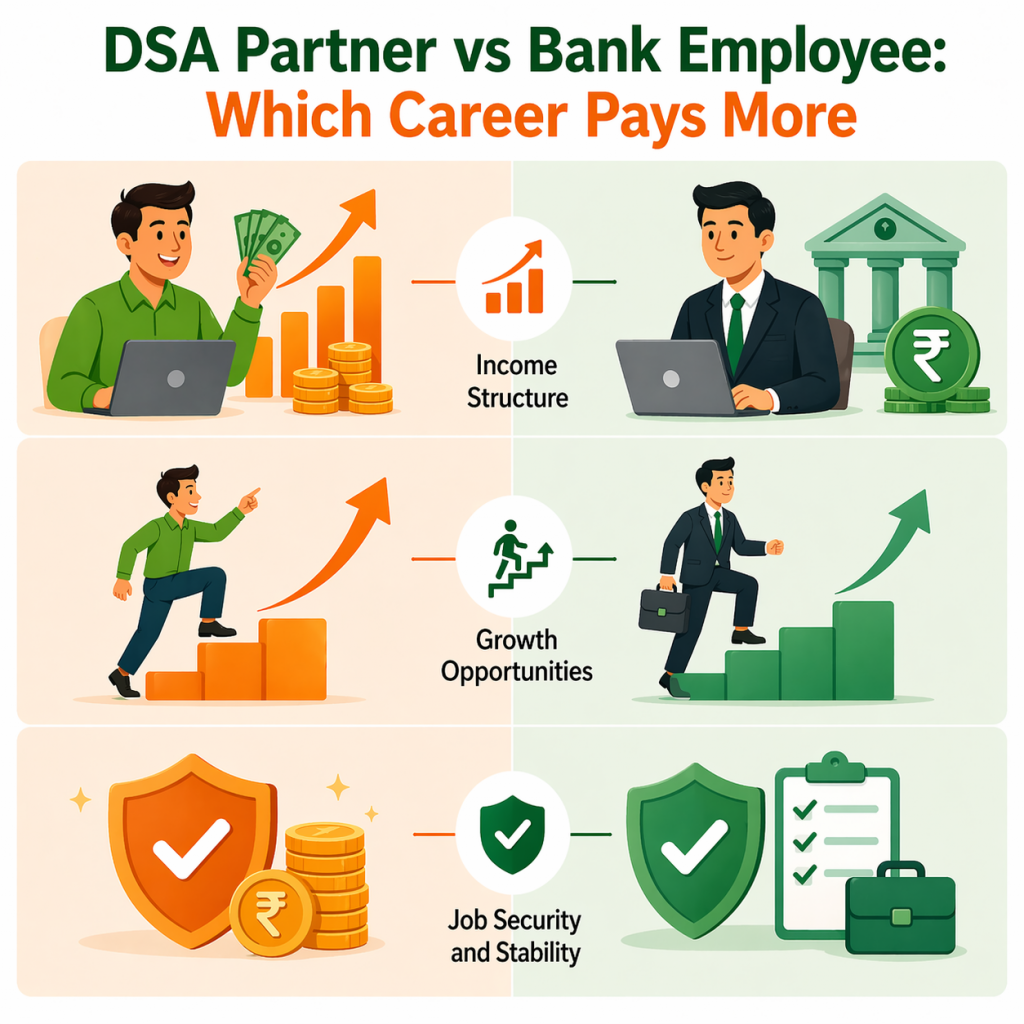
As shown above, a DSA earns based on performance. Meanwhile, a bank employee earns a fixed monthly salary.
Therefore, income stability is higher in bank jobs. However, earning potential is higher in DSA roles.
| Factor | DSA Partner | Bank Employee |
| Income type | Commission-based | Fixed salary |
| Monthly earnings style | Changes with deals | Stable and planned |
| Growth speed | Can be fast with sales | Usually steady and gradual |
| Risk level | Higher | Lower |
| Flexibility | High | Limited |
Salary and Earnings Potential in 2026
In 2026, both careers offer good income opportunities. However, the earning pattern is very different.
A bank employee earns between ₹20,000 and ₹60,000 per month at the start. Moreover, with experience, this can increase to ₹80,000 or even ₹1 lakh.
On the other hand, a DSA partner has no income limit. Initially, they may earn ₹15,000 to ₹30,000. However, with experience, income can grow to ₹1 lakh to ₹5 lakh or more per month.
Therefore, DSA offers higher earning potential. However, it requires consistent effort and performance.
Fixed Income vs Commission-Based Income
This is one of the biggest differences.
A bank employee earns a fixed income every month. Therefore, they can plan expenses easily. Moreover, they feel financially secure.
In contrast, a DSA earns commission. So, income may change every month. However, strong performance can bring high rewards.
For example, a DSA may earn more in one month than a bank employee earns in three months.
Therefore, risk is higher in DSA. However, rewards are also higher.
Growth Opportunities in Both Careers
Growth matters in every career. However, growth paths differ here.
In a bank job, growth is slow but steady. Employees get promotions over time. Moreover, exams and experience play a big role.
In a DSA career, growth depends on performance. A DSA can build a network, add more clients, and even create a team. Therefore, growth can be faster.
In addition, DSAs can expand their business across cities. So, their income can increase quickly.
Job Security and Stability Comparison
Job security is very important for many people.
A bank employee enjoys strong job security. Moreover, government bank jobs are highly stable. Therefore, people prefer them for long-term careers.
On the other hand, a DSA partner does not have fixed job security. Income depends on deals and market demand.
Therefore, if you prefer stability, bank jobs are better. However, if you can take risks, DSA is a good option.
Also Read: https://deliverables.kosmi.in/learn-dsa-documents-required/
Work Flexibility and Lifestyle Differences
Work-life balance is also important.
A bank employee works fixed hours. Therefore, their routine is stable. However, they have less flexibility.
In contrast, a DSA partner can choose their working hours. So, they enjoy more freedom.
For example, they can work from home, meet clients anytime, and manage their own schedule.
However, this freedom also requires discipline. Without effort, income will drop.
Skills Required for Each Career
For DSA partners:
- Communication skills
- Sales ability
- Networking skills
- Self-motivation
For bank employees:
- Financial knowledge
- Customer service skills
- Attention to detail
- Computer knowledge
Therefore, DSAs need strong people skills. Meanwhile, bank employees need process skills.
Pros and Cons of Being a DSA & Bank Employee
| Feature | DSA (Direct Selling Agent) | Bank Employee |
| Pros | Unlimited income potential, Flexible working hours, Faster career growth, Independence | Stable salary, Job security, Employee benefits, Structured growth |
| Cons | No fixed income, High competition, Income uncertainty, Requires continuous effort | Limited income growth, Fixed schedule, Less flexibility, Slow promotions |
Which Career Pays More in 2026
Now let’s answer the main question.
In 2026, a DSA partner can earn more than a bank employee. However, this depends on performance.
If a DSA builds strong connections and closes more deals, income can increase quickly. Moreover, top DSAs earn multiple times more than bank employees.
However, a bank employee earns a steady income. So, the risk is low.
Therefore, DSA offers higher earning potential. Meanwhile, bank jobs offer stability.
Who Should Choose DSA as a Career
You should choose DSA if you like sales and communication. Moreover, if you want flexible working hours, this role is a good choice.
In addition, if you want high income potential and can handle risk, DSA is ideal.
Who Should Choose a Bank Job
You should choose a bank job if you want stability. Moreover, if you prefer a fixed salary and structured work, this is better.
Also, if you value job security and low risk, bank jobs are ideal.
Conclusion
Both DSA and bank employee careers are good options. However, they suit different people.
If you want flexibility and high income, DSA is a strong choice. On the other hand, if you want stability and security, a bank job is better. Partner with a certified DSA agency like WeRize. Join WeRize to start selling their financial products and increase your earnings.
Therefore, your choice should depend on your goals, skills, and comfort with risk.
Also Read: https://deliverables.kosmi.in/about-us-why-werize/