English


Introduction
Fixed deposits (FDs) are one of the most popular savings options in India. They are safe, easy to open, and guarantee returns. However, interest rates often change based on market trends. Because of that, a new product called the Floating Rate FD has become popular.
This type of FD gives you the benefit of earning interest that moves with market rates. As a result, when interest rates rise, your returns also go up. On the other hand, when market rates fall, your earnings may reduce slightly. Nevertheless, many investors prefer it because it keeps their savings aligned with market performance.
Moreover, floating-rate FDs are becoming an attractive option for people who wish to stay flexible with changing financial conditions.
What Is a Floating Rate FD
A Floating Rate FD (Fixed Deposit) is a type of deposit where the interest rate is not constant during the investment period. Instead, it moves up or down depending on the benchmark rate decided by the bank or financial institution.
In simple words, your FD’s interest changes when market interest changes. Therefore, the rate “floats” rather than staying fixed. Consequently, investors can benefit when bank deposit or government bond rates rise.
For example, imagine you invest in a Floating Rate FD linked to the RBI repo rate. When the repo rate increases, your FD interest also goes up. Conversely, if the repo rate drops, your returns decrease.
In addition, this flexibility allows investors to earn more when the economy performs well.
How Floating Rate Fixed Deposits Work
Floating Rate FDs work based on a benchmark link. Most banks tie them to the Reserve Bank of India (RBI) repo rate or other government rates.
Here’s how it usually works:
- The bank sets an initial interest rate when you open the FD.
- The rate is reviewed periodically, often every three months or six months.
- If the benchmark interest rate changes, the FD rate adjusts accordingly.
Thus, your investment keeps up with market rates instead of being locked to one fixed number. In simple terms, the rate change depends on how the benchmark moves.
Let’s look at a simple example in the table below.
| Period | RBI Repo Rate | Floating FD Interest Rate | Rate Change |
| January | 6.50% | 6.75% | N/A |
| April | 6.75% | 7.00% | Increased |
| July | 6.25% | 6.50% | Decreased |
| October | 6.50% | 6.75% | Increased |
Clearly, the FD interest moves whenever the RBI repo rate changes. That’s why it’s called “floating.” Furthermore, it ensures your returns remain responsive to real market movements.
Difference Between Floating Rate FD and Fixed Rate FD
While both are FDs, the key difference lies in the interest rate.
- Fixed Rate FD: The interest remains constant throughout the tenure.
- Floating Rate FD: The interest changes based on market conditions.
Because of this, floating rate FDs offer flexibility, while fixed rate FDs offer stability. As a result, choosing between them depends on your financial goals.
For instance, during times when interest rates are expected to rise, floating rate FDs give better returns. But during rate cuts, fixed-rate FDs can be safer for investors who want steady income. Moreover, blending both can balance safety and growth.
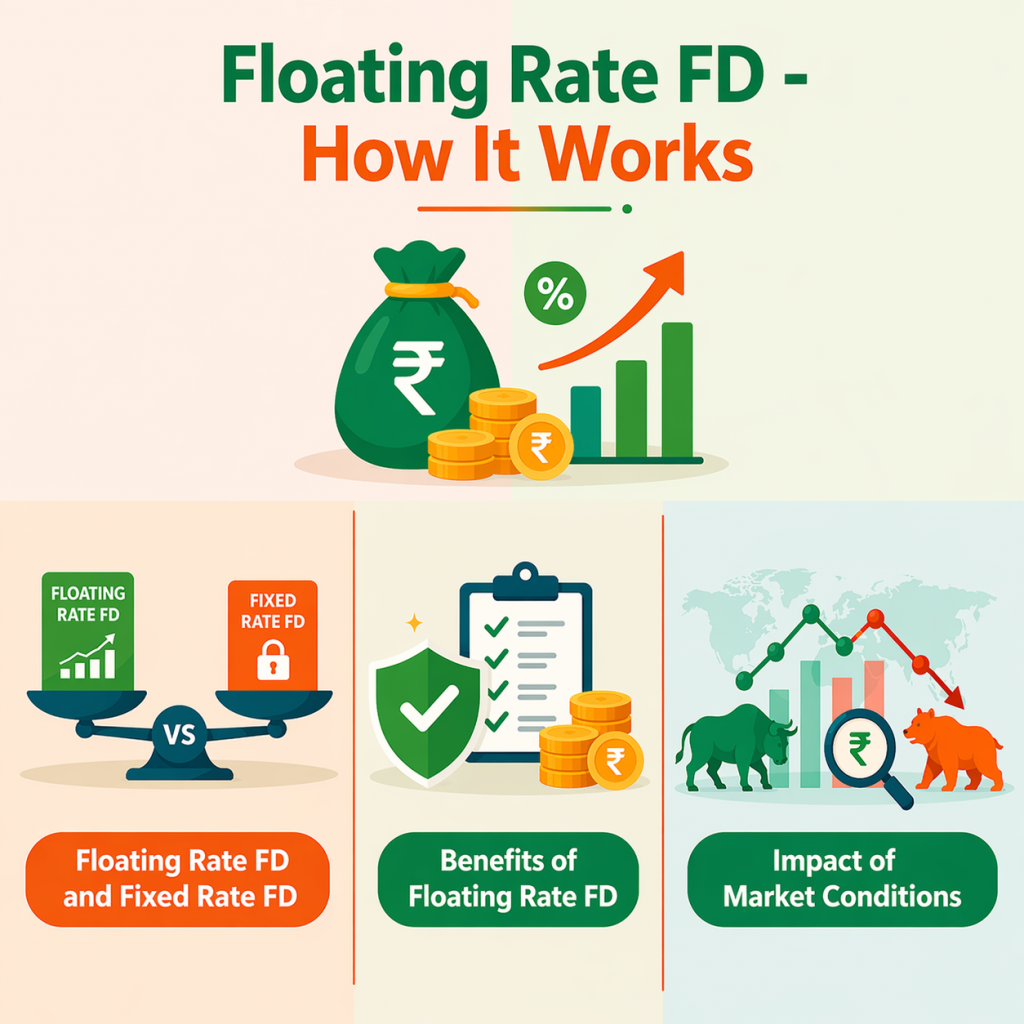
How Interest Rates Affect Floating Rate FDs
Interest rates play a major role in floating rate FDs. Typically, the bank links the FD to the RBI repo rate or other benchmark instruments.
When the RBI increases the repo rate, banks charge more for loans but also pay higher interest on deposits. That automatically raises your FD returns. In contrast, when the RBI lowers rates, FD interest also drops.
Therefore, if you believe rates will rise, investing in a floating rate FD can be smart. Conversely, during falling rate cycles, fixed FDs might feel more secure. Additionally, keeping track of policy changes can guide your investment timing.
Benefits of Choosing a Floating Rate FD
Choosing a floating rate FD offers many benefits. Here are the key ones:
- Rising Return Potential: When the economy improves and interest rates increase, your FD’s return also grows.
- Market-Linked Flexibility: You don’t miss out on new rates introduced by banks.
- Better Long-Term Gains: Over time, floating rate FDs can outperform fixed ones during growing interest cycles.
- Balance Between Safety and Profit: You still enjoy the security of an FD but with the potential for higher rewards.
- Diversification Option: You can mix floating-rate and regular FDs in your portfolio to manage risks.
Additionally, floating rate FDs can serve as a hedge when inflation causes rate changes, helping your money keep pace with the economy.
Risks of Floating Rate Fixed Deposits
However, floating-rate FDs are not risk-free. Like any investment, they have some downsides.
- Falling Interest Risk: If market interest rates fall, your FD return also drops.
- Rate Uncertainty: You cannot predict exact returns since they depend on market conditions.
- Limited Availability: Not all banks offer floating rate FDs.
- Reinvestment Risk: At maturity, future rates may not remain favorable.
Nevertheless, careful planning and proper timing can reduce uncertainty. Moreover, diversifying your portfolio helps you balance this risk effectively.
When Should You Choose a Floating Rate FD
You should consider choosing a floating rate FD during times when interest rates are expected to rise.
For example:
- When the economy is improving.
- When inflation is high, the RBI raises rates.
- When government bond yields are increasing.
On the other hand, if rates are stable or falling, a fixed-rate FD might be a better choice. Therefore, staying updated about economic changes will help you make smarter choices.
In short, choose a floating rate FD when you want to stay connected to market changes and benefit from rising rates. Furthermore, it suits investors who are comfortable with short-term fluctuation for long-term gain.
Floating Rate FD vs Regular FD
Let’s compare both types side-by-side.
| Features | Floating Rate FD | Regular FD |
| Interest Rate | Changes with market | Fixed throughout |
| Risk | Moderate | Low |
| Return Potential | High during the rising rate period | Stable |
| Market Link | Yes | No |
| Ideal For | Dynamic investors | Conservative investors |
From this comparison, it’s clear that floating rate FDs suit people who can handle small fluctuations but want better long-term returns. Additionally, they offer a flexible alternative during dynamic economic periods.
Impact of Market Conditions on Returns
Market conditions directly influence floating rate FD performance.
When inflation rises or the RBI increases repo rates, floating FDs give higher returns. However, when economic slowdown or rate cuts occur, returns may slide slightly. Consequently, investors must stay informed about market trends.
Therefore, keeping an eye on economic news helps you decide when to invest or hold back. Moreover, consulting a financial advisor can help you map out a better deposit strategy.
Who Should Invest in Floating Rate FDs
Floating rate FDs are ideal for:
- Investors who expect interest rates to rise.
- People who can handle minor fluctuations in returns.
- Long-term savers looking for market-linked growth.
- Individuals who want both safety and flexibility.
Furthermore, if you are new to investing, you might start with a mix of fixed and floating FDs to understand how they work together. Over time, you’ll gain confidence in balancing risk and reward.
Things to Consider Before Investing
Before opening a floating rate FD, remember a few key points:
- Understand the Benchmark: Check which rate your FD is linked to (like RBI repo).
- Review Adjustment Frequency: Know how often your interest changes—quarterly or semi-annually.
- Compare Banks: Different banks offer different rates and linkages.
- Look at Historical Trends: This helps predict possible rate movements.
- Plan Tenure Carefully: Longer tenures give more exposure to rate cycles.
- Check Penalty Terms: If you withdraw early, understand how it affects returns.
Therefore, taking time to review these factors can help you make smarter financial decisions. Moreover, comparing online options simplifies your selection process before investing.
Conclusion
A floating rate FD gives investors a smart way to grow their savings with market trends. It allows your deposit to benefit when interest rates rise and keeps your investment adaptive.
However, because rates can move both up and down, timing and understanding market conditions are essential. Hence, for those who want flexibility plus safety, this FD works beautifully. It bridges the gap between traditional stability and dynamic returns. Choose an FD plan that will benefit you with higher returns. Start your investments with WeRize Fixed Deposits.
So, if you expect rising interest rates, now might be a good time to explore floating rate FDs offered by trusted banks. Additionally, diversifying between floating and fixed FDs can balance your overall savings plan.
Also Read: https://deliverables.kosmi.in/history-of-fixed-deposits/
FAQs
1. What is the main benefit of a floating rate FD?
It offers the chance to earn higher interest when market rates rise, unlike fixed FDs that stay constant.
2. Can floating rate FDs have losses?
No, you won’t lose your principal, but your interest earnings may reduce if market rates fall.
3. How often does the interest change?
Most banks review floating FD rates every three or six months, depending on the linked benchmark.
4. Are floating rate FDs available in all banks?
Not always. Some private and government banks offer them, while others may still focus on regular FDs.
5. Can senior citizens invest in floating-rate FDs?
Yes, and they may get slightly higher floating interest rates compared to other investors.
6. Is TDS applicable to floating rate FD interest?
Yes, similar to regular FDs, if your yearly interest exceeds ₹40,000 (₹50,000 for senior citizens), TDS applies.