English


Are you tired of paying high monthly EMIs on your home loan? If so, you are not alone in this struggle. Millions of Indian borrowers wait for good news every year. Specifically, they watch the Reserve Bank of India (RBI) closely. Consequently, the RBI’s monetary policy directly impacts your monthly budget.
Currently, in April 2026, everyone asks the exact same question. Will the repo rate drop in FY 2026-27? Therefore, this detailed blog will break down everything you need to know. First, we will explain the basic financial terms simply. Then, we will explore expert predictions. Ultimately, you will learn to plan your finances better.
What is the Repo Rate?
To begin with, we must understand this basic banking term. The repo rate is the interest rate at which the RBI lends money to commercial banks. For example, imagine you need money quickly. You go to a bank and apply for a personal loan.
Similarly, banks sometimes need extra cash for daily operations. Therefore, banks borrow funds directly from the RBI. In return, the RBI charges them a specific interest fee. This fee is the actual repo rate. As a result, when this rate increases, borrowing becomes expensive for banks.
Consequently, banks pass this extra cost on to you. Conversely, when the RBI lowers the rate, banks get cheaper money. Thus, they usually offer cheaper loans to retail customers. Furthermore, the entire economy reacts to these changes.
How Does the Repo Rate Affect Your Money?
Next, let us see how this impacts your daily life. The repo rate acts as an anchor for all interest rates. Consequently, it changes how much you pay and earn. First, let us look at your monthly debt. If the rate goes up, your home loan EMI increases immediately.
In addition, personal loans and car loans become more expensive. Therefore, buying a new house feels much harder. On the other hand, higher interest rates benefit conservative investors. Specifically, banks increase the interest rates on Fixed Deposits (FDs). Thus, your savings grow much faster.
However, borrowers always hope for major rate cuts. After all, a lower rate means smaller monthly payments. Therefore, your financial strategy must adapt to these RBI decisions.
Current Economic Scenario in Early 2026
Currently, we are in the first quarter of FY 2026-27. The financial market looks quite interesting right now. Over the past year, the RBI kept interest rates stable. Specifically, they wanted to control high food inflation across India. Furthermore, global events forced the central bank to remain cautious.
As a result, home loan interest rates stayed high. Consequently, many middle-class families delayed buying new properties. Additionally, existing borrowers felt the heavy burden of expensive EMIs. However, retail inflation finally shows clear signs of cooling down. Food prices are stabilizing across the country.
Therefore, financial experts believe a policy shift might happen soon. Indeed, the new financial year brings fresh hope for borrowers. We might finally see relief in the coming months. Ultimately, the RBI will review the data carefully before acting.
Home Loan EMI Impact Table
Before we discuss predictions, let us look at a simple comparison. This table shows how rate changes affect your money.
| Financial Factor | High Repo Rate Impact | Low Repo Rate Impact |
| Home Loan EMI | Goes up | Goes down |
| Fixed Deposit Returns | Earn more interest | Earn less interest |
| Car Loans | More expensive | Cheaper to borrow |
| Business Expansion | Slows down | Speeds up |
Repo Rate Predictions for FY 2026-27
Now, let us discuss the main predictions for FY 2026-27. Many economists expect a positive shift this coming year. First, they predict the RBI will finally announce a rate cut. Specifically, experts forecast a reduction of 0.50% by late 2026.
Consequently, your home loan interest rate could drop significantly. Furthermore, banks will quickly adjust their floating rate home loans. Thus, your monthly EMI will decrease automatically. Alternatively, your total loan tenure might become shorter. In either case, you will save a lot of interest.
However, no one expects a sudden or massive drop. Instead, the RBI will likely take slow and careful steps. They want to protect the economy from sudden shocks. Therefore, expect gradual relief rather than overnight magic.
Why Might the RBI Cut the Repo Rate?
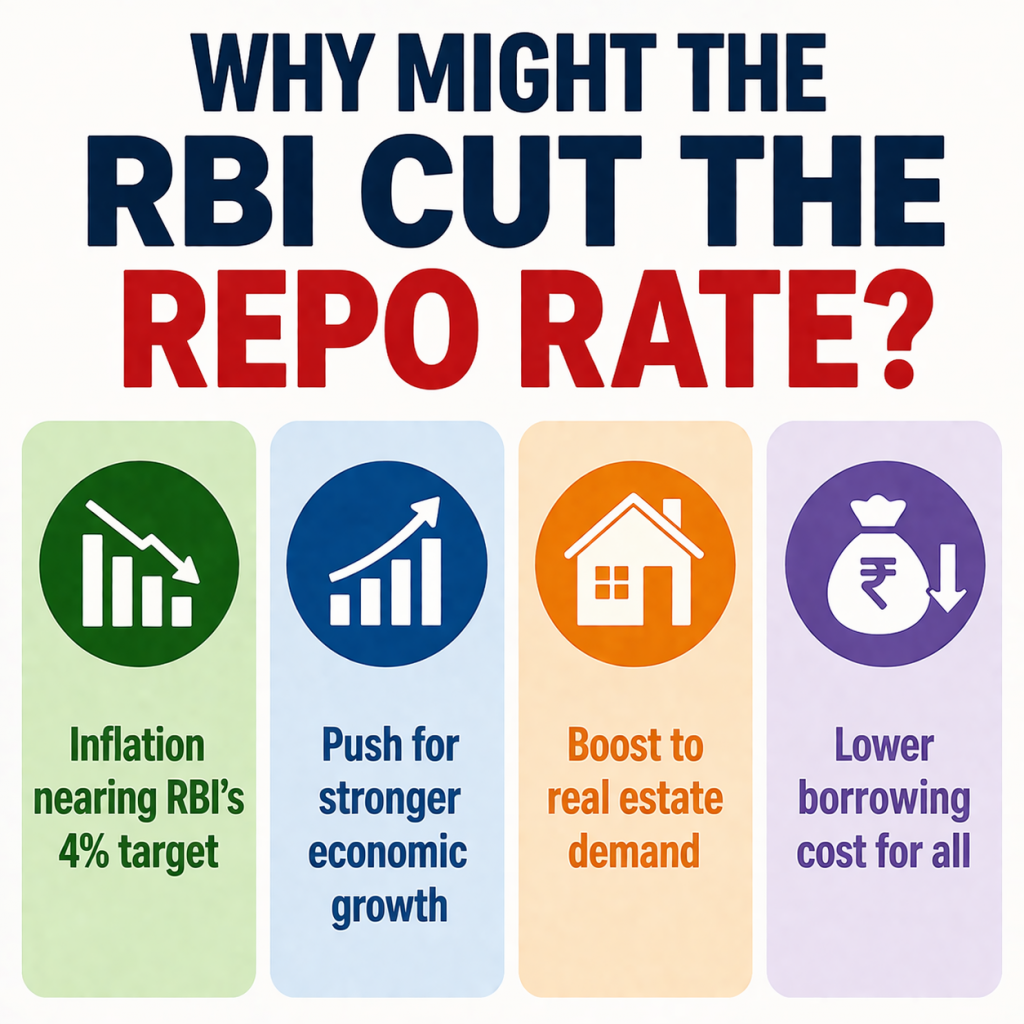
You might wonder why experts predict a rate cut. Several positive factors support this hopeful forecast. First, domestic retail inflation is finally coming under control. The RBI always targets an inflation rate near 4 percent. Currently, the numbers are moving closer to this safe zone.
Therefore, the central bank has less reason to maintain high rates. Second, the government wants to boost overall economic growth. Lower interest rates encourage businesses to borrow and expand quickly. Consequently, this creates jobs and increases consumer spending.
Third, the real estate sector needs a strong financial push. Cheaper home loans will definitely attract more property buyers. Ultimately, a rate cut helps both common people and industries. Thus, a small reduction makes perfect economic sense now.
Why Might the RBI Keep the Repo Rate Unchanged?
On the other hand, we must look at the risks. The RBI might decide to keep the repo rate unchanged. First, global economic conditions remain highly unpredictable right now. For instance, global conflicts can increase crude oil prices. If oil becomes expensive, inflation in India rises again.
Consequently, the RBI will refuse to cut rates anytime soon. Second, the US Federal Reserve also influences Indian markets heavily. If the US keeps its interest rates high, India usually follows. Otherwise, foreign investors might pull their money out quickly.
Furthermore, sudden weather changes can ruin local crops. As a result, food inflation could spike unexpectedly later this year. Therefore, the RBI will closely monitor all threats. Hence, they might choose safety over aggressive rate cuts.
Smart Tips to Manage Your Home Loan EMI
Regardless of the repo rate, you must protect your finances. Fortunately, you can take control of your loan today. First, consider making partial prepayments every single year. Even a small extra payment reduces your principal amount quickly. Consequently, your total interest burden drops significantly.
Second, try to increase your monthly EMI amount slightly. If your income increases, direct that extra money toward your loan. Thus, you will close the loan much faster. Third, monitor other banks for better interest rate offers.
If another lender offers a lower rate, transfer your balance immediately. However, always calculate the processing fees before switching banks. Finally, maintain an excellent credit score for future benefits. Banks always offer the cheapest rates to good customers. Therefore, pay your bills on time.
Conclusion
To summarize, the repo rate plays a crucial role in your life. It dictates exactly how much your dream home will cost. For FY 2026-27, expert predictions look quite optimistic. Specifically, economists expect a slight reduction in interest rates later this year. Consequently, your EMIs might finally drop.
However, you should not wait for the RBI to act. Instead, take proactive steps to manage your debt today. For example, start prepaying your loan whenever you get extra cash. Furthermore, look out for smart balance transfer opportunities. Ultimately, good financial planning matters most. Therefore, make wise choices with your money.
FAQs
1. What exactly is the repo rate?
Simply put, it is the interest rate the RBI charges commercial banks. When banks borrow money, they pay this rate. Consequently, it influences all other loan rates.
2. Will my fixed-rate home loan EMI change?
No, your fixed EMI will not change. Fixed-rate loans stay the same for a specific period. However, most Indian home loans use floating rates. Therefore, floating rates change with the repo rate.
3. When will the RBI announce the next rate change?
The RBI monetary policy committee meets every two months. Consequently, they review the economic situation six times a year. Therefore, check financial news regularly for updates.
4. Should I wait for rates to drop before buying a home?
Not necessarily, because property prices change quickly. If you find a good property, buy it now. Later, you can refinance your loan. Furthermore, property prices might increase if you wait.
5. How can I lower my current EMI immediately?
First, talk to your bank about lowering your interest rate. Often, they will reduce it for a conversion fee. If they refuse, transfer your home loan to another lender.